

by Garth Callender MBA GAICD
This year marks twenty-five years since Australian troops first deployed to Afghanistan. It is twenty-three years since we sent forces to Iraq, and twenty-seven since Australia led the international force into East Timor. A child born when the first soldiers went to Afghanistan is now an adult. For them, and for much of the country, these are events from history books. For those of us who served, they remain close.
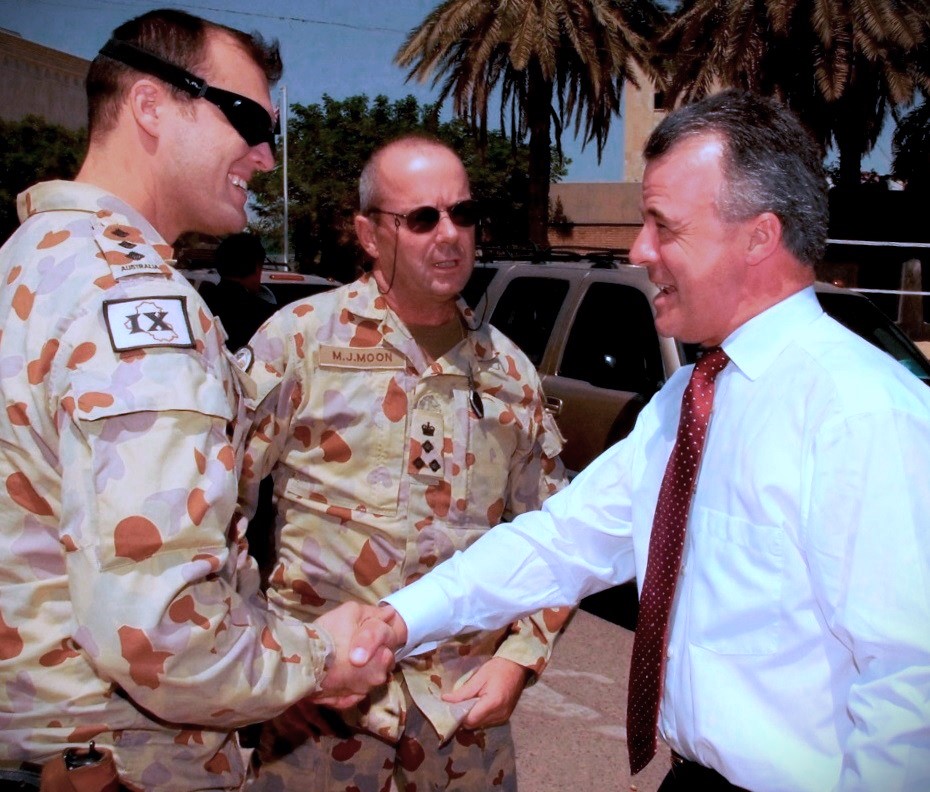
I deployed to Baghdad in 2004 and 2006, and to Afghanistan over 2009 and 2010. In 2004 I was wounded in an IED attack. I have spent much of the time since thinking about what that generation of service meant, and what it should mean for the country that sent us.
That is why this anniversary matters. It is not an exercise in nostalgia, and it should not become a simple argument about success or failure. It is a chance to take a clear-eyed view of what Australia asked of a generation, what that generation gave, and what the country owes to the record they left behind.
Start with who went. Tens of thousands of Australians served across those theatres: sailors, soldiers, aviators, medics, engineers, logisticians, intelligence specialists, reservists, and police and public servants who deployed alongside them. Some were on their first deployment, and some were on their fifth or sixth. They came from every state and territory, from country towns and big cities, and they did the work they were asked to do.
The cost was real. Forty-one Australians died in Afghanistan, and hundreds more were wounded. Many who came home carried injuries that could not be seen: the slow damage of repeated deployments, of loss, of moral injury, of trying to explain to people at home what cannot easily be explained. Families carried it too. Partners and children adjusted their lives around the person who came back, or the one who did not.
The Royal Commission into Defence and Veteran Suicide, which reported in 2024, made clear that the cost did not stop when the deployments did. It showed how much harm can be done in the space between serving and civilian life, and how long it took the country to see it. That is a hard finding to sit with. It is also a sign of a nation prepared to look at itself honestly.
We have had to do that in other ways as well. The Brereton Inquiry exposed conduct by a small number of Australians that fell far short of the standards the rest held itself to. It was painful, and it was necessary. Those who served honourably, which was the overwhelming majority, have every reason to want that accountability. An institution earns trust by facing hard truths, not avoiding them.
But these twenty-five years cannot be remembered only through loss, inquiry and regret. There is also a great deal to be proud of.
In Afghanistan, over two decades, Australians trained Afghan soldiers and police, supported reconstruction, and worked alongside local communities in some of the most difficult terrain in the world. Australian medical teams advanced trauma care in ways that now save lives in civilian hospitals at home. In August 2021, as Kabul fell, the ADF helped evacuate thousands of people, many of them Afghans who had stood beside us.
In Iraq, Australians contributed to security and later helped train Iraqi forces in the fight against Daesh. The work was long, largely unheralded, and skilfully done.
In East Timor, where this generation of service began, an Australian-led force helped a new nation take its first steps, and that partnership endures.
There is another part of the legacy that rarely gets noticed. Many of the same people who deployed overseas have been the ones who turn up when Australia is in trouble at home. Bushfires, floods, a pandemic: the ADF has been there, and much of that capability was built on the experience of these deployments. A generation of leaders learned judgement, resilience and ethics under pressure that no classroom could teach. Many of them now hold senior roles across defence, government, business and community life.
The fall of Kabul left many veterans asking whether it had been worth it. I do not think there is a single answer. Most of us hold two things at once: pride in what we did and in the people we did it with, and sadness about how it ended and what it cost. Both feelings are legitimate. Neither cancels the other.
What does twenty-five years mean to Australia? It means the story is no longer a recent one. The soldiers who deployed in 2001 are now in their forties and fifties. They are raising families, running businesses and serving their communities. Their service is a settled part of our national history.
Think again of that child born in 2001. They are now about the age many of us were when we first deployed. They will inherit this history as a record rather than a memory, and that makes the record matter. It should be remembered in full: the loss, the failures and the honest reckoning that followed, alongside the steady, ordinary competence of tens of thousands of people who did a hard job well, a long way from home.
I do not need that history to be simple. I would like it to be accurate, so that whoever picks it up next finds the names of the dead, the work of the living, and the full account of what Australia asked of them. That is a record those who served can stand behind.
Biography
Garth Callender MBA GAICD is the CEO of Bravery Trust, a national charity providing practical financial assistance and support to veterans and their families facing hardship. A serving Army officer with more than 30 years’ service, he is committed to supporting veterans and their families when they need it most.